
I take a pencil and a large white piece of paper and begin it’s construction.
I am free to choose from all the colors I have on my desk but I choose the pale gray of the pencil for the magical property it possesses.
I can make a mistake because I can erase it. We can always make mistakes but mistakes cost. Time, mostly. If you think about it, everything else we think we’ve lost after a mistake is a child of time because if you had an endless life course, each mistake would have zero value since the next moment would make up for the previous lost one without subtracting itself from the sum total of your finite moments.
Therefore, with a rough reflection, I get an idea of the value of time in my life. At the moment I have not come to a conclusion as to whether this value is given by me or is inevitably possessed by time, from the moment it existed as a concept. Again, something confuses the reasoning because I have also not come to a conclusion as to whether time has always existed or has existed as soon as I gave birth to it in my mind. I will not make an assumption on the matter. Depending on the path my thought wants to follow, it will adopt the corresponding objects that will accompany it.
You know, every little idea was based on some fake objects to structure itself and every new one that seems bigger is also based on fake objects, it just has to wait for the next idea to expose the fraud. Until that happens, the objects will look real and the thinking will look right. But you see that eventually they are all fake, just less fake than the previous ones. Or not, in fact. The point is not to find the real thing. I won’t disappoint you by telling you that it doesn’t exist if you’ve spent so long not figuring it out for yourself. I’ll just tell you that you’ll never be able to find it and you’ll then hate me a little and start walking away. If you manage to stay, you’ll have gotten a little closer to the truth but you’ll still never touch it. You choose whether to be satisfied with your steps or only when those steps have taken you somewhere you think you are going. No destination exists. But each step is worth taking to bring you closer to it.
So I was talking of the pencil’s ability to avoid mistakes since it can be erased. With the pencil, error no longer exists on my map. You can perhaps say that its meaning will have changed. Error is now an alternative path that I discovered and did not want to follow. I think the concept of error is beginning to take on a positive connotation. It was a gift I had not planned to receive and so I rejected it, but now I am aware of its existence. I became a little richer than before. But why did I really not accept the gift? Why didn’t I choose to continue with the mistake and pave a new path ahead of me? Because I had a clear idea of my path and the mistake was not part of the plan. So, the property of the mistake that makes it discarded is surprise. When I see it interacting with the other elements of the course, I give it a negative charge that is not so much due to its objective contribution to the picture but to how I had imagined my picture. In a world where there would be no errors, no course could be interrupted, but it would be extremely short and sparse. If we tried to incorporate the error into the design so that it ceased to exist as an error, we could never obtain a definite course.
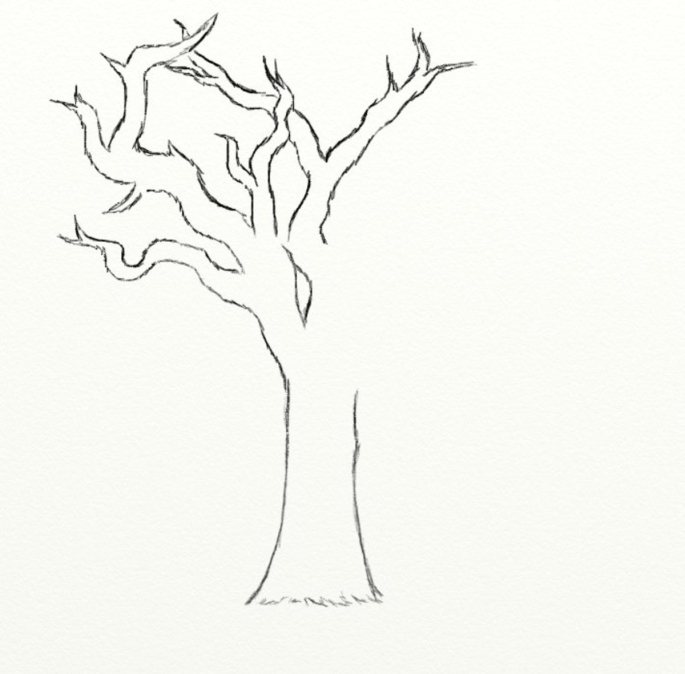
Think of being a water molecule starting its course on the branch of a tree. Suppose you aim to reach the end, the end of the branch so that you have traversed it all. You start, you move on, and suddenly you meet another branch. We can call it a potential error, if you understand the reasoning. If you see the branch as erroneous, you will dismiss it and keep going along the main branch web. You will encounter another error, and another, and you will avoid them all one by one as obstacles to the path you have set. It’s safe to say that you will cease to see them in a short time, accustomed by their appearance and focused on your shining goal. In a short time you will have reached your goal, the top of the great branch, and happily you will have completed your course. Suppose now that while you were at the beginning of the branch and encountered the branches, you did not reject them but followed them. You follow the first branch, move on and meet another smaller one, in the branch you are already on. You can follow that one and it will lead you to another smaller one and so on. Either way, eventually you will meet a peak.
Each branch leads you to a terminal in the end. None leads to an infinite road. And every top, even if it belongs to a main large branch or a series of branches, leads you to the end of the tree. None is inferior to the other. So I’ve assured you that you’re bound to get somewhere in the end. In the first case, you will go somewhere in particular, following a steady course and without having fallen into error. In the second, you are indifferent to where you will end up and you go randomly following the branches which will take you to a place you had not planned beforehand. There is also the possibility that you aim for the top of the big branch and get confused by following a branch without realizing it. At some point, you will probably realize the different path you took and now comes the issue of making a mistake. You can go back to where you were before you made the mistake and continue towards your goal, or you can forget about the goal and see the branch as an opportunity to get somewhere unplanned.
In this example, four instances of a course were mentioned. In the first, there was a goal and there were never any mistakes. It was a short and clear path to the goal. In the second case, there was never a goal, or rather the goal was the path rather than a specific end, but with less randomness and more tendency towards branches. So far, in both cases, error has never existed as a concept. Then, in the third path, there was a specific goal, the path to it was lost, the concept of error was created, the error was discarded as a path, and finally the goal was conquered, albeit in a longer period of time, since there was a return to the original path. In the fourth case, there was a specific goal, at some point the error was created but it lost its meaning and was renamed to “an opportunity”. Eventually the original goal was not achieved but the error ceased to exist.
The end of the story would have been the same whichever course had been followed. Eventually the molecule would reach some peak, some edge. What changes is its path, and the emotions that arise on each one. Whether it avoided,pursued, corrected or embraced the possible error that occurred.
The rest of the conclusions are up to you to create. You know why you started reading, why you stayed and which course you loved the most.
Besides, I just wanted to explain why I sometimes like to draw with pencil.

 Signal In Noise